Jiawei Niua,Youqiang Yua,Jiaji Xia,Tim Sternb,Abdelnasser Mohamedc
aState Key Laboratory of Marine Geology, Tongji University, Shanghai, 200092, China
bSchool of Geography, Environment and Earth Sciences, Victoria University of Wellington, Wellington, 6140, New Zealand
cEgyptian National Seismic Network (ENSN), Seismology Department, National Research Institute of Astronomy and Geophysics (NRIAG), Helwan, Cairo, 11421, Egypt
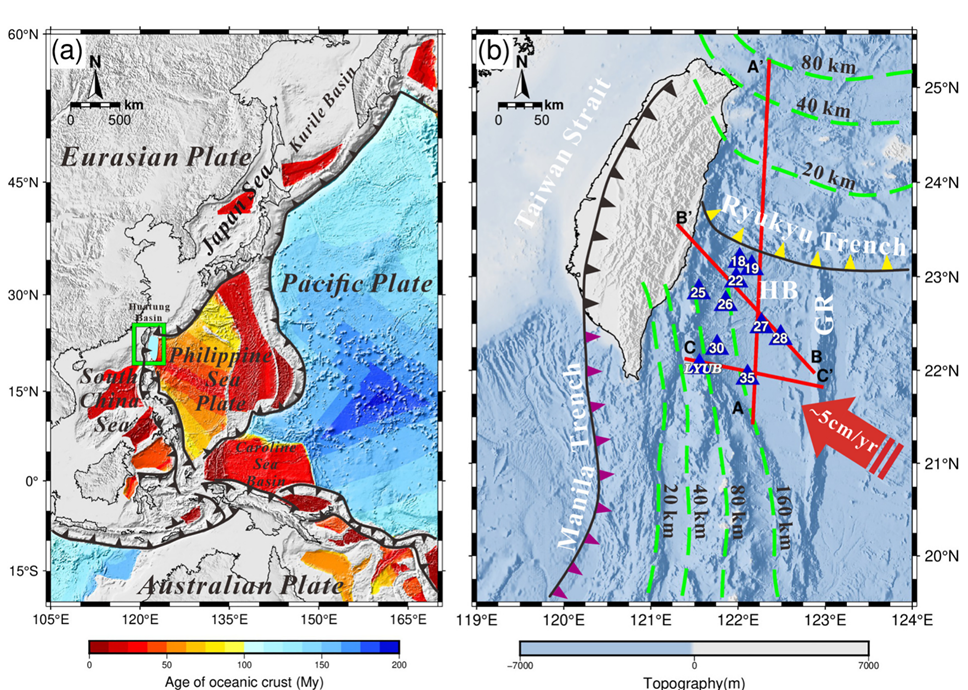
Abstract: Oceanic subduction is a fundamental driver of global geodynamic processes, including plate tectonics and mantle circulation. Extensive investigations have been dedicated to the mantle wedge atop subducting slabs, yet mantle dynamics seaward of trenches, especially flow beneath incoming oceanic plates, remain inadequately characterized. Here we employ ocean-bottom and island seismic data to present the first shear-wave splitting constraints on upper-mantle anisotropy beneath the Huatung Basin (HB), a Mesozoic oceanic lithospheric remnant along the western Pacific margin. The resulting splitting measurements reveal pronounced lateral variations in upper-mantle anisotropy and inferred mantle flow. NW–SE fast orientations in the central-eastern HB are parallel to absolute plate motion (APM) and are consistent with APM-related shear in the asthenospheric mantle. In the southwestern HB, fast orientations rotate to near E–W, compatible with an increasing contribution from trench-normal corner flow associated with eastward subduction along the Manila Trench. The northern HB shows the clearest departure from the APM-parallel pattern, with dominant NNE–SSW fast orientations generally perpendicular to the Ryukyu Trench and splitting times of up to 2.20 s. Considered together with previous studies, these observations favor an important contribution from mantle entrainment associated with northward Ryukyu subduction.
Full Article:https://doi.org/10.1016/j.tecto.2026.231427