Pham Nhu Sang a Zhifei Liu a, Yulong Zhao a, Pham Trung Hieu b c, Sopheak Thav d, Sopheap Den d
a State Key Laboratory of Marine Geology, Tongji University, Shanghai 200092, China
b Faculty of Geology, VNU-HCM University of Science, Ho Chi Minh 700000, Viet Nam
c Vietnam National University, Ho Chi Minh 700000, Viet Nam
d Faculty of Forestry Science, Royal University of Agriculture, Phnom Penh 120000, Cambodia
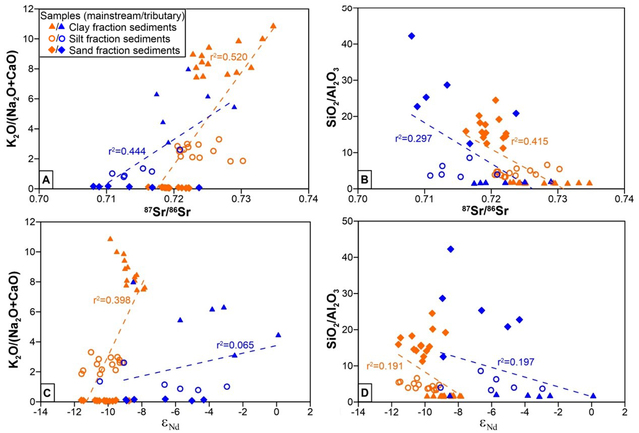
Abstract: Sr-Nd isotopic compositions are reliable proxies for tracing the provenance of riverine and marine sediments. However, these isotopic compositions can be influenced by processes such as chemical weathering in the source region and grain size sorting during transport, which can obscure the original provenance signals. In this study, Sr-Nd isotopic compositions of clay, silt, and sand fractions from river sediments in the Lower Mekong River Basin are analyzed to investigate the influence of chemical weathering and grain size sorting and their implications for provenance studies. Mainstream sediments exhibit higher 87Sr/86Sr (0.724) and lower εNd (−9.72) values compared to tributary sediments (0.717 and − 5.61, respectively). The clay fractions in both mainstream and tributary sediments show more radiogenic 87Sr/86Sr (0.726) and higher εNd (−7.29) values than the silt (0.721 and − 8.88, respectively) and sand (0.718 and − 9.27, respectively) fractions. Rb/Sr and 87Sr/86Sr in both mainstream and tributary sediments present moderate or strong correlations with K2O/(CaO + Na2O) and SiO2/Al2O3, indicating that chemical weathering and grain size sorting moderately influence Sr isotopes. In contrast, Sm/Nd and εNd display no or weak correlations with K2O/ (CaO + Na2O) and SiO2/Al2O3, suggesting that Nd isotopes are less affected by these factors. Despite these influences, significant differences in Sr-Nd isotopic compositions between mainstream and tributary sediments are evident, with moderate to strong negative correlations between 87Sr/86Sr and εNd across clay, silt, and sand fractions. These differences effectively distinguish the mainstream from the tributary sediments, reflecting the control of source rock lithology and the preservation of source rock signatures in this region. To minimize the effects of chemical weathering and grain size sorting, this study recommends using Sr-Nd isotopic data from uniform grain size fractions for provenance investigations of riverine and marine sediments, with the silt fraction being the most suitable.
Full article:https://doi.org/10.1016/j.chemgeo.2025.123199