Jinniu Chen1, Chao Li1, Wenshen Xiao1, Nicholas Chia Wei Ng1, Weibo Lai1, Junfei Chen1, Chi Zhang2, Shouye Yang1
1 State Key Laboratory of Marine Geology, Tongji University, Shanghai, China
2 Exploration and Development Research Institute, Petro China Southwest Oil & Gasfield Company, Chengdu 610041, China
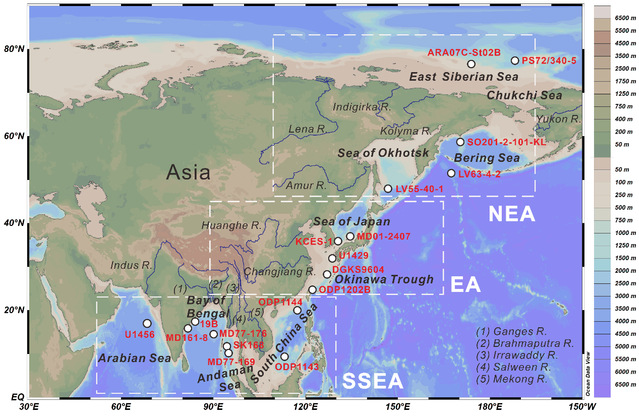
Abstract: Continental weathering plays a crucial role in maintaining the equilibrium of the carbon cycle and Earth's habitability. Interpreting weathering records registered in marginal sea sediments is a key approach to understanding the mechanisms of continental weathering. However, these weathering indices are often influenced by factors such as catchment lithology, mineral sorting during river transport, and diagenetic modifications during deposition. Thus, accurately interpreting the geological significance of these weathering indices remains a challenge in continental weathering research. In this study, we compiled a series of published sediment archives (<100 ka) from the continental margin of Asia. By comparing Chemical Index of Alteration (CIA) values and other common chemical weathering indices in these records, we attempted to identify the patterns of weathering records and their controlling factors along the Asian continental margin. The weathering indices in Asian continent marginal seas sediments are primarily influenced by two factors: Temperature and Sea Level. Comprehensive comparison of chemical weathering indices from multiple sediment cores, spanning from tropical to Arctic regions, revealed stronger weathering in tropical areas and weaker weathering in polar regions. The impact of sea level on weathering indices can be further attributed to changes in sediment provenance or variations in the weathering area, e.g., the exposure of the continental shelf. In low-latitude marginal seas (Arabian Sea, Bay of Bengal, Andaman Sea, and northern South China Sea), chemical weathering intensity is associated with temperature, consistent with glacial-interglacial cycles. In mid-latitude marginal seas (Okinawa Trough and Sea of Japan), sediment weathering intensity is dominated by sediment provenance changes driven by sea level fluctuations. In high-latitude marginal seas (Sea of Okhotsk, Bering Sea, Chukchi Sea, and East Siberian Sea) and the southern South China Sea, chemical weathering intensity is stronger during glacial periods and weaker during interglacial periods. This pattern is attributed to enhanced weathering of unconsolidated shelf sediments exposed during glacial sea level lowstands and the increased fracturing of rocks and sediments due to glacial erosion in polar regions. This study provides a novel perspective for deciphering silicate chemical weathering signals registered in the Asian continent marginal seas in the late Quaternary, and helps us explore the factors influencing continental weathering in sedimentary records in continental margins.
Full article: https://doi.org/10.1016/j.earscirev.2025.105377