Zhengbing Peng a, Rujian Wang a, Wenshen Xiao a, Xiaobo Jin a, Haowen Dang a, Shengbin Ye a, Li Wu b, Xingxing Wang a, Fenghao Liu a, Shaohua Dang a
a
a. State Key Laboratory of Marine Geology, Tongji University, Shanghai 200092, China,
b. College of Ocean and Meteorology, Guangdong Ocean University, Zhanjiang 524088, Guangdong, China.
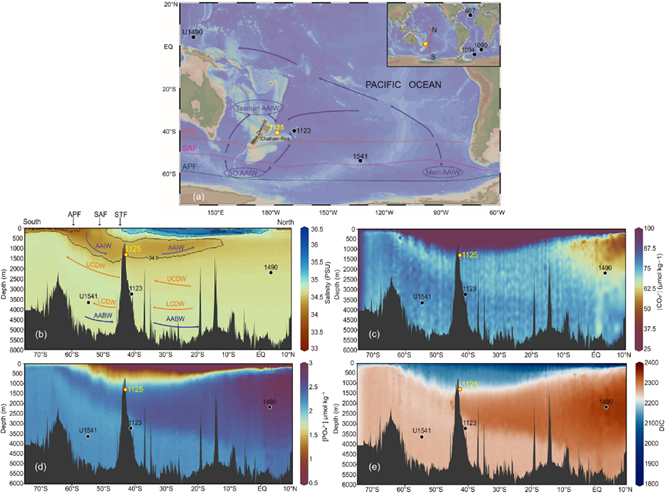
Abstract: The Antarctic Intermediate Water (AAIW) establishes a physical link between high and low latitudes, delivering signals of carbon and nutrients variations from the Southern high-latitudes to low-latitude oceans. However, the change in carbon storages associated with AAIW across the Mid-Pleistocene Transition (MPT) remains poorly constrained. In this study, we present benthic foraminiferal B/Ca, Cd/Ca, and sortable silt records from the Southwest Pacific, reconstructing dissolved inorganic carbon (DIC) concentration and current speed in AAIW over the past 400–1350 kyr. Our records reveal a long-term expansion of the mid-depth carbon reservoir across the MPT. Further, by deconvolving B/Ca-derived ∆[CO32−] and Cd/Ca-derived [PO43−], we distinguish between physical and biological drivers of DIC change. We find that carbon storage during the early MPT (1050–900 ka) was driven by Southern Ocean biological processes, while a shift to a regime dominated by enhanced Southern Ocean stratification and weakened circulation characterized in the late MPT (900–650 ka) and before MPT (1350–1200 ka). Notably, the sustained expansion of the mid-depth carbon reservoir was synchronous with Antarctic Ice Sheet growth, suggesting a crucial role of their combined effects in the global cooling/glaciation both before MPT and in the late MPT.
Full article: https://doi.org/10.1016/j.gloplacha.2026.105470