Simon V. Hohl a, Yi-Bo Lin b, Philipp Gleissner c, Eva . Stüeken d, Yuxiang Jiang e, Sebastian Viehmann f
aState Key Laboratory of Marine Geology, Tongji University, Shanghai, PR China
bSchool of Earth Sciences and Engineering, and Frontiers Science Center for Critical Earth Material Cycling, Nanjing University, Nanjing 210023, PR China
cDepartment of Earth Sciences, Freie Universität Berlin, Germany
dSchool of Earth & Environmental Sciences, University of St Andrews, St Andrews, UK
ePetroChina Research Institute of Geology, Hangzhou, PR China
fInstitute of Earth System Sciences, Section Mineralogy, Leibniz University Hannover, Germany
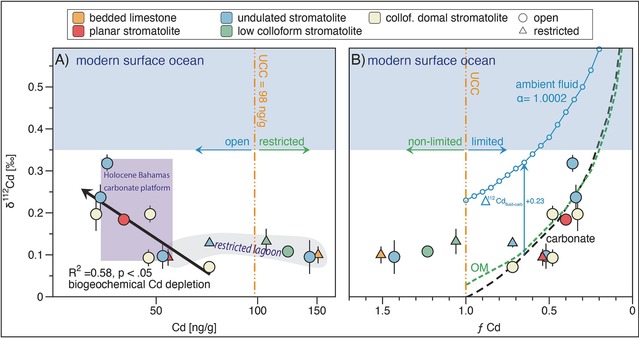
Abstract:Stromatolitic carbonates are vital archives for understanding the complex interactions among the microbial biosphere, hydrosphere, and atmosphere. At the Rabenkopf section in the Oberpullendorf Basin of the Parathetys, planar, undulated, and domal stromatolites of the Ritzing Formation record the Middle Miocene Badenian Salinity Crisis. We used the combined Ba-Cd isotope tracer along with trace element systematics to infer nutrient availability and primary productivity in a Neogene microbial environment under extreme environmental stress caused by basin restriction and related evaporation. We find that while productivity in microbial habitats during restricted conditions does not cease, the microbial communities adapt to changing nutrient conditions, developing isotopic signatures that are increasingly controlled by heterotrophic over phototrophic metabolism. Under restricted and freshwater input conditions, stromatolitic carbonates record lower Cd, Ba, and S isotopic conditions at variable, but negative, C isotopic conditions. Together with elevated Ba and Cd concentrations these hint at progressive organic matter remineralization via bacterial sulphate reduction or halophilic bacteria-mediated barite dissolution. In contrast, more open basin conditions correlate with heavier Ba, Cd and S isotopic conditions, arguing for the formation of micro-barites on extra polymeric substances from a marine sulphate pool and Rayleigh-type Cd isotope fractionation in ambient fluids to values similar to modern productive open surface ocean conditions. This work emphasises the importance of macro- and micronutrient availability and the adaptability of microbial environments during severe climatic and environmental changes in Earth’s history. Examining novel stable metal isotope systems, especially the combined Ba-Cd tracer, can serve as a blueprint for better understanding both ancient and modern microbial habitats affected by the ongoing climate crisis.
Full article:https://doi.org/10.1016/j.gca.2026.01.027