
In recent days, Chinese scientists aboard the Research Vessel (R/V) “Tongji” have been carrying out a continuous “carbon-tracking” expedition in the northern South China Sea, focusing on geological proxies and records of the ocean carbon cycle.
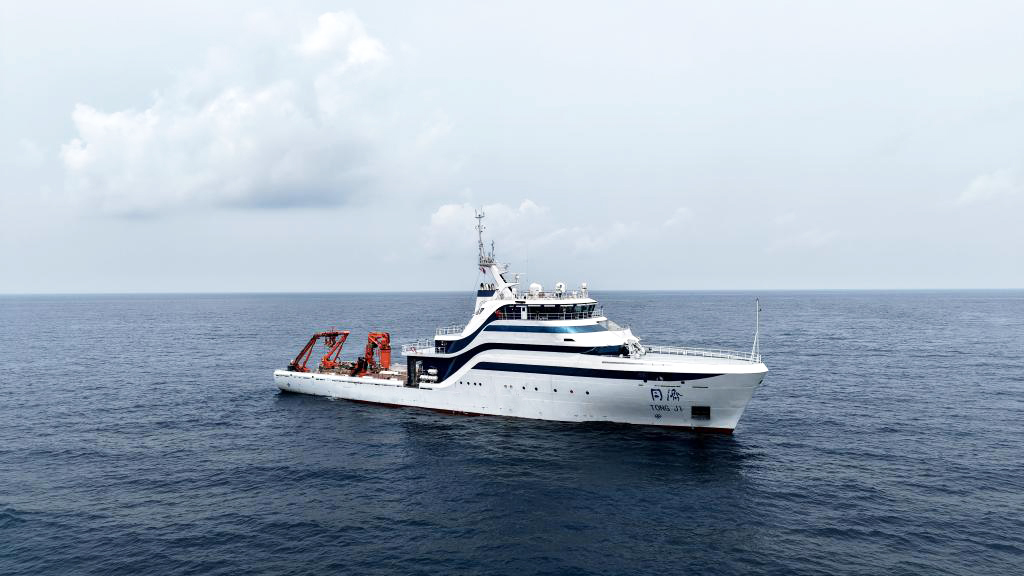
The R/V “Tongji” conducted its spring voyage in the South China Sea
Spring marks the “lull” between the winter and summer monsoons in the South China Sea, and it is also the “prime time” for scientific expeditions.
In the early hours of April 20, the R/V “Tongji” reached its first station for the spring voyage. Under the illuminated stern deck against the dark sea, a team of 30 expedition members from Tongji University, the University of Science and Technology of China, and other institutions conducted a series of operations, including multibeam and shallow-water profiling, seawater and sediment pore water sampling, and gravity coring. Late that night, the team proceeded directly to operations at the next station.
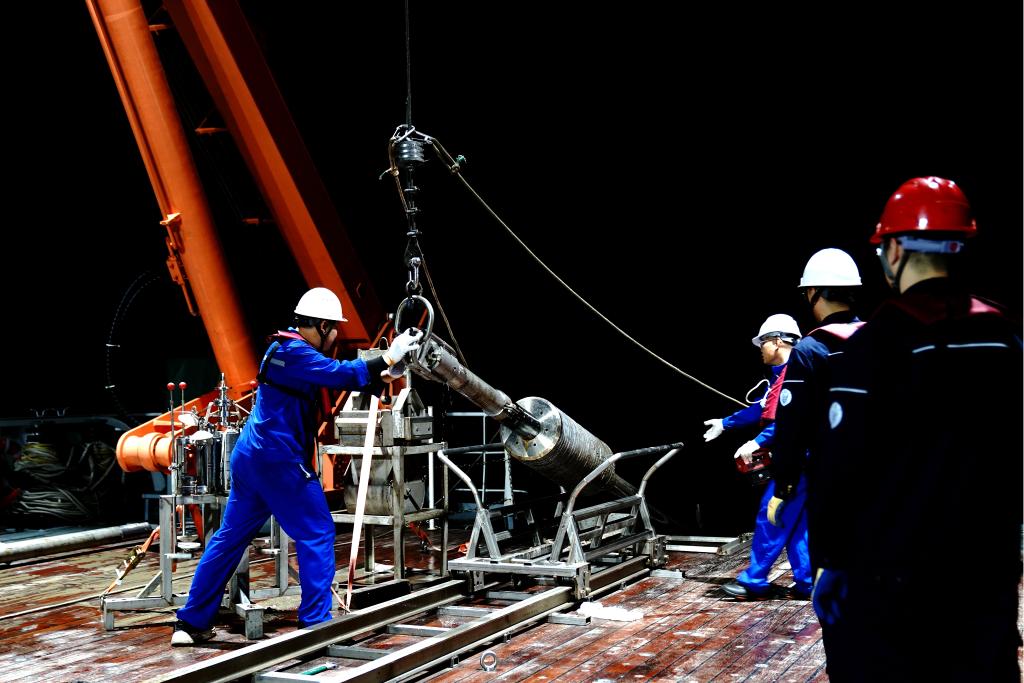
In the early hours of April 20, expedition members prepared to deploy a gravity corer on the stern deck of the R/V “Tongji”
The ocean, which cover 71% of the Earth’s surface, serves as a major carbon reservoir. Through air–sea exchange, surface waters absorb atmospheric carbon dioxide and transport it into the deep ocean—a process known as the “ocean carbon pump,” which operates via both physical and biological pathways.
“In recent years, advances in remote sensing and long-term observations have revealed significant spatial and temporal variability in the efficiency of the ocean’s biological carbon pump, making it a key driver of climate change. However, its underlying mechanisms remain insufficiently understood and require further investigation,” said by Professor TIAN Jun, chief scientist of the expedition from the School of Ocean and Earth Science at Tongji University. “Based on the samples collected during this cruise, we are pursuing four parallel approaches to trace geological indicators and records of the marine carbon cycle.”
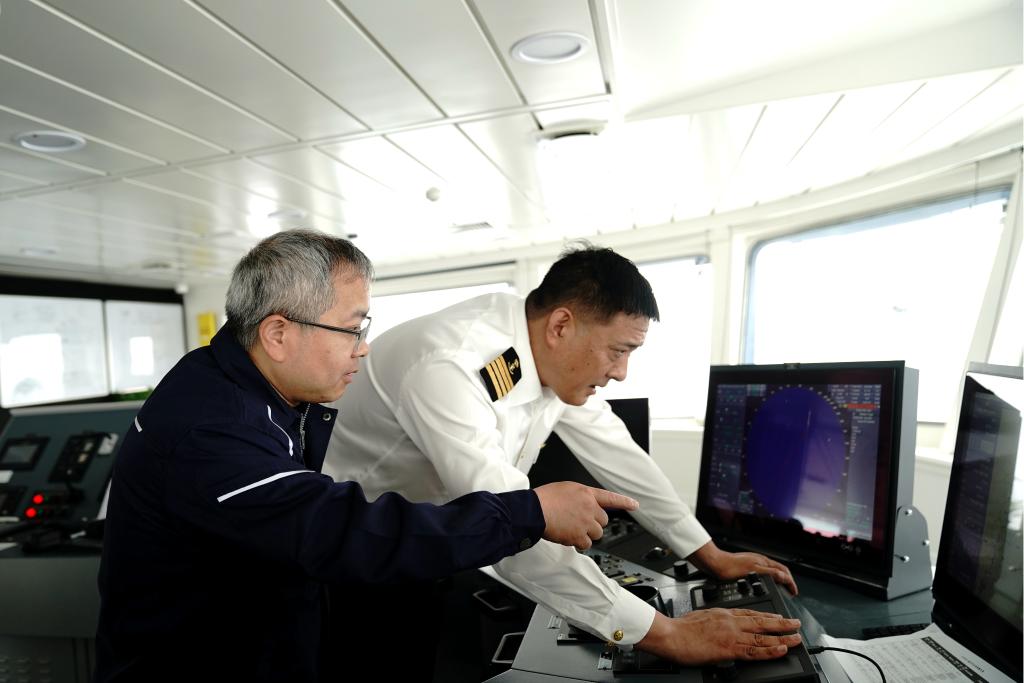
Professor TIAN Jun (left), chief scientist of the South China Sea spring expedition aboard the R/V “Tongji”, and Captain SHI Bin (right) discussed the operational planning for sampling stations
The first approach involves identifying molecular fossils of various eukaryotic algae at different water depths to determine which species are most effective at carbon fixation. The second focuses on marine prokaryotic phytoplankton, particularly cyanobacteria, to assess their contribution to carbon sequestration throughout Earth’s history. The third seeks to expand observational datasets to better understand coccolithophores, which play a dual role in carbon cycling. The fourth investigates neodymium isotopic signatures in pore waters of deep-sea sediments to indirectly trace spatiotemporal variations in the oceanic carbon reservoir.
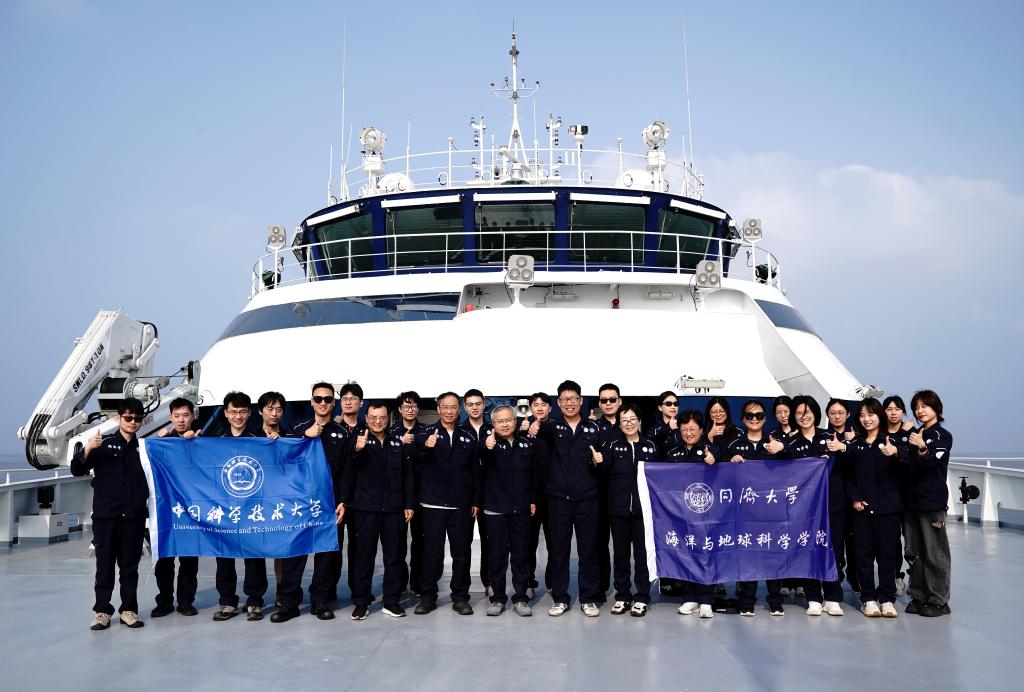
Expedition members from Tongji University and the University of Science and Technology of China
Accurate chronological frameworks are essential to all these approaches. Onboard the R/V “Tongji”, a team led by Professor JIANG Wei from the School of Physical Sciences at the University of Science and Technology of China is applying atom-trap trace analysis, an ultrasensitive isotopic detection technique, to advance the use of calcium-41 dating in Earth and environmental sciences.
“Conventional radiocarbon dating is limited to about 30,000 years,” JIANG Wei explained. “Our independently developed calcium-41 dating method extends this range to approximately 500,000 years. It has already shown promising results in dating ocean drilling sediments from the western Pacific and the South China Sea. During this expedition, we aim to further refine the method through systematic analysis of surface sediments from the continental slope of the South China Sea.”
“The ocean’s biological carbon pump is one of the key mechanisms through which marine ecosystems regulate Earth’s environment via carbon cycling, playing a crucial role in maintaining planetary habitability,” TIAN Jun added. “By investigating its evolution through multiple approaches, we are effectively opening a ‘spatiotemporal window’ into the processes that have shaped a habitable Earth.”
Written by: ZHANG Jiansong
Shot by: ZHANG Jiansong
Translated by: LI Xinran