Arsenic cycling driven by hydrogeochemical-tidal coupling in a sandy subterranean estuary
Wenli Xia a, Long Gao b, Jiawei Liu a, Yiqing Wang a, Zijun Wu a
a State Key Laboratory of Marine Geology, Tongji University, Shanghai 200092, China
b Guangxi Institute of Marine Geological Survey, Beihai 536000, Guangxi, China
Abstract
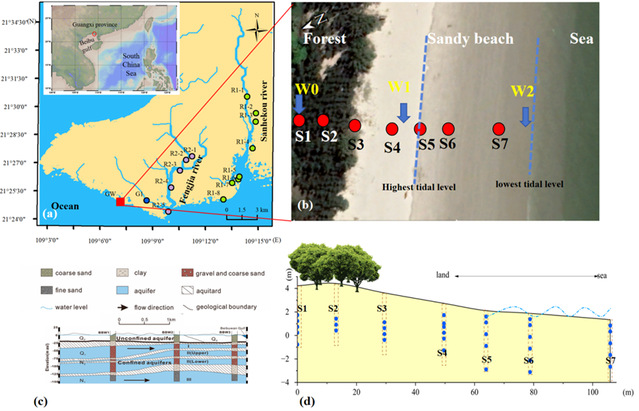
Submarine groundwater discharge (SGD) represents a significant but often poorly quantified pathway for terrestrial contaminants, such as arsenic (As), to the coastal ocean. This study investigates As dynamics in a subtropical sandy subterranean estuary (STE) located in Beihai, China. Our findings reveal that recirculated saline groundwater discharge (RSGD) dominates the seaward flux of As. Although dissolved As concentrations remain below the WHO guideline (<10 μg L−1) throughout the STE, the total SGD-derived As flux (0.25 ± 0.03 kg d−1) exceeds combined inputs from local rivers. The STE functions as both a filter and a conduit for As. Within the intertidal zone, the Upper Saline Plume (USP) facilitates seaward As transport from the mixing zone via tidal recirculation, while sediments at its base effectively remove terrestrially derived As through Fe-Si-As coprecipitation and adsorption onto iron oxides. Tidal pumping is the key driver, simultaneously intensifying the oxic conditions that enable this near-shore As sequestration and promoting seawater-groundwater exchange that sustains reducing conditions in deeper recirculation zones. In these anoxic zones, As mobility is regulated by Mn-oxide reductive dissolution and competitive anion exchange (notably with silicate and phosphate), which also controls As(III)/As(V) speciation. This work establishes STE as the dominant pathway for terrestrial As to the coastal ocean in this system. We propose a conceptual model that integrates tidal hydrodynamics with redox and adsorption geochemistry to explain As cycling in sandy STEs, providing a critical framework for predicting and managing As dynamics in vulnerable coastal systems worldwide.
Full article:https://doi.org/10.1016/j.jhydrol.2026.135630