Xun Yu1, Zhifei Liu1, Gang Zeng2, Li-Hui Chen3, Pham Nhu Sang1, Long Van Hoang4, Youqiang Yu1, Jian Zhao3, Julin Zhang5
1 State Key Laboratory Of Marine Geology, Tongji University, 1239 Siping Road, Yangpu District, Shanghai 200092, China
2 State Key Laboratory Of Critical Earth Material Cycling And Mineral Deposits, Nanjing University, 163 Xianlin Road, Qixia District, Nanjing 210023, China
3 State Key Laboratory Of Continental Evolution And Early Life, Department Of Geology, Northwest University, 229 Taibai North Road, Beilin District, Xi’an 710069,
China
4 Tectonics Society, Vietnam Union of Geological Sciences, 6 Pham Ngu Lao Street, Hoan Kiem Ward, Hanoi 100000, Vietnam
5 Department of Earth Science, Rice University, 6100 Main Street, Houston, TX 77005, USA
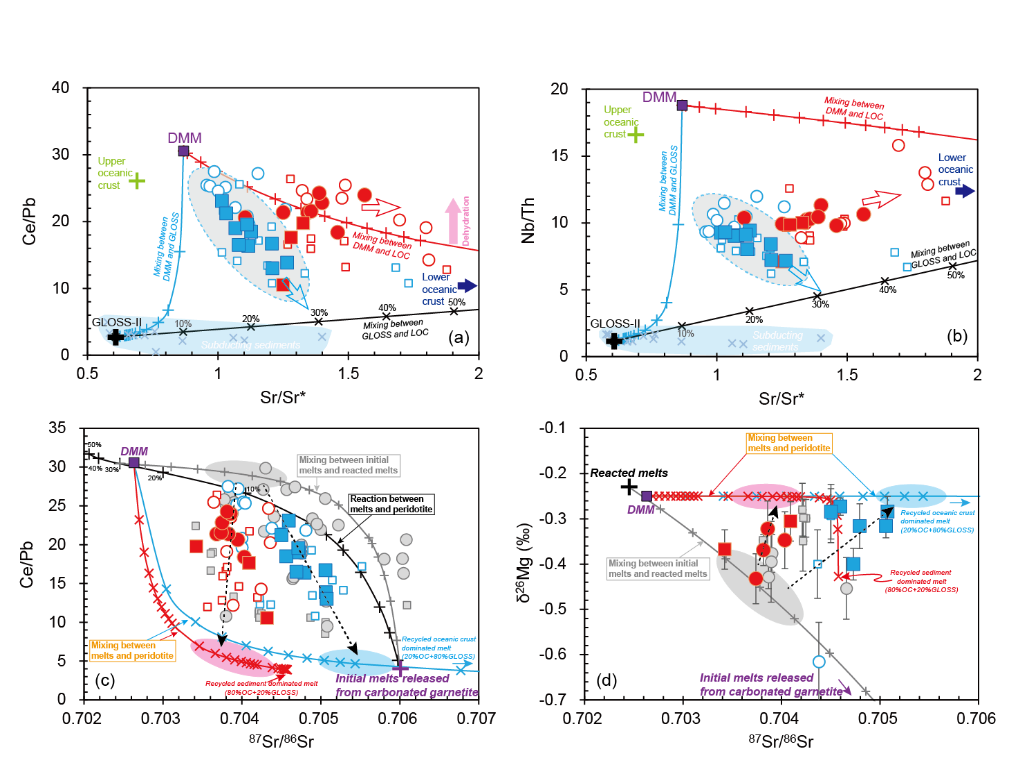
Abstract:Intraplate basalts, exhibiting a continuous geochemical spectrum from alkaline to tholeiitic compositions, are extensively distributed along the continental margins of eastern and southeastern Eurasia, where subducted oceanic slabs are stagnant in the mantle transition zone (MTZ). The genetic relationship between the coexistence of alkaline and tholeiitic magmatism, the alkaline-tholeiitic transition, and upper mantle dynamics remains enigmatic. We present Sr, Nd, Mg, and Fe isotopic data, combined with major and trace elemental compositions, for the Late Cenozoic Buon Ma Thuot (BMT) and Pleiku (PLK) basalts from southern Vietnam to investigate these mantle processes. Changes in Mg and Fe isotopic values of these basalts are associated with their alkaline-tholeiitic transition. Besides higher MgO, TiO2, CaO/Al2O3, and lower SiO2, alkaline basalts exhibit lower δ26Mg (−0.32‰ – −0.43‰) and higher δ57Fe values (+0.16‰ – +0.37‰) than tholeiitic basalts (i.e. δ57Fe varies from + 0.09‰ to + 0.21‰), which resemble normal mid-ocean ridge basalts. Trace element ratios and Sr and Nd isotopes of the studied basalts vary spatially. BMT basalts display Ce/Pb (18.4–24.2) and Nb/Th (9.80–11.3) ratios akin to those of oceanic crust, coupled with elevated positive Sr anomalies (Sr/Sr* = 1.10–1.56) and constant low 87Sr/86Sr ratios, indicating the presence of recycled lower oceanic crust in their mantle source. In contrast, the mantle source of PLK basalts appears to incorporate more recycled sediments, as indicated by their lower Ce/Pb (13.0–23.1) and Nb/Th (7.16–9.43) ratios, along with elevated 87Sr/86Sr ratios and decreased εNd values. The alkaline-tholeiitic transition in both BMT and PLK basalts arises from differences in their source lithologies and melting processes. Spatial geochemical variations can be further ascribed to the small-scale lateral heterogeneity of the mantle, which arises from the recycling of various segments of subducted slabs. Given that BMT basalts erupted prior to PLK basalts, and considering the geophysical evidence (such as receiver function investigations and P-wave velocity models) indicating slab edges and mantle upwelling in the MTZ, we suggest that the observed geochemical variations in intraplate basalts are primarily driven by the upward flow of fractured oceanic slabs, facilitated by slab tearing processes occurring within the MTZ.
Full Article:https://academic.oup.com/petrology/article/67/6/egag048/8699847