Jianxiong Hu , Enqing Huang ,Peijun Qiao ,Man Zhao , Guodong Jia , Jun Tian
State Key Laboratory of Marine Geology, Tongji University, Shanghai, 200092, China
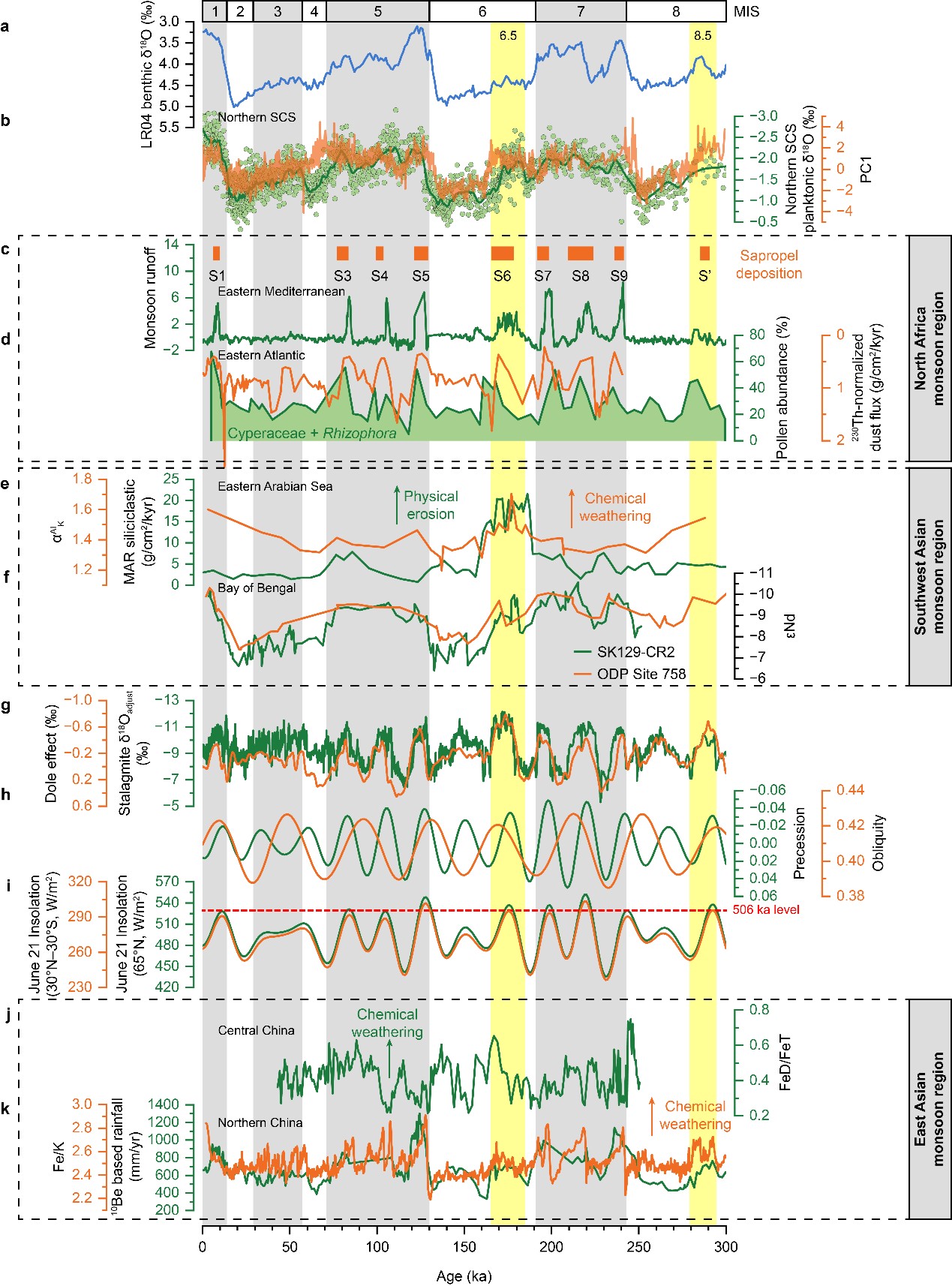
Abstract: Understanding orbital-scale variations of the East Asian summer monsoon (EASM) in subtropical East Asia remains challenging due to strong spatial heterogeneity and the complexity of proxy interpretations. Here we investigate the hydroclimate evolution in this region over the past ca. 300 kyr using high-resolution planktonic foraminiferal δ18O records and major element ratios of sediments from multiple cores in the northern South China Sea. To disentangle the dominant modes of major element compositional variability, we apply principal component analysis (PCA) to Ti-normalized molar element ratios from six records across five core sites. Two dominant modes are identified: the first principal component primarily reflects grain-size sorting, whereas the second principal component reflects the influx of terrigenous input, with both processes modulated by sea-level changes. During Marine Isotope Stage (MIS) 6.5, the results of PCA reveal an anomalous increase in fine-grained terrigenous input that was decoupled from sea-level changes. Concurrently, planktonic δ18O records display pronounced negative excursions that deviated markedly from global ice-volume trends and were accompanied by strongly depleted local seawater δ18O. Together, these records suggest an anomalous hydroclimate intensification under glacial boundary conditions in subtropical East Asia, which has also been documented broadly across the Afro–Asian monsoon domain. However, this intensification appears moderate in northern China relative to the subtropical region. We propose that the combined effects of precession minimum and extensive Eurasian ice sheets caused the Intertropical Convergence Zone to linger over subtropical East Asia, prolonging the summer monsoon season and producing a spatially divergent but pronounced hydroclimate intensification during MIS 6.5.
Full article:https://doi.org/10.1016/j.quascirev.2026.110149