Sihua Wei a, Weipeng Zheng b, Jinlong Du a, Jilin Wei b, Yongqiang Yu b, Jun Tian a
aState Key Laboratory of Marine Geology, Tongji University, Shanghai, 200092, China
bInstitute of Atmospheric Physics, Chinese Academy of Sciences, Beijing, 100029, China
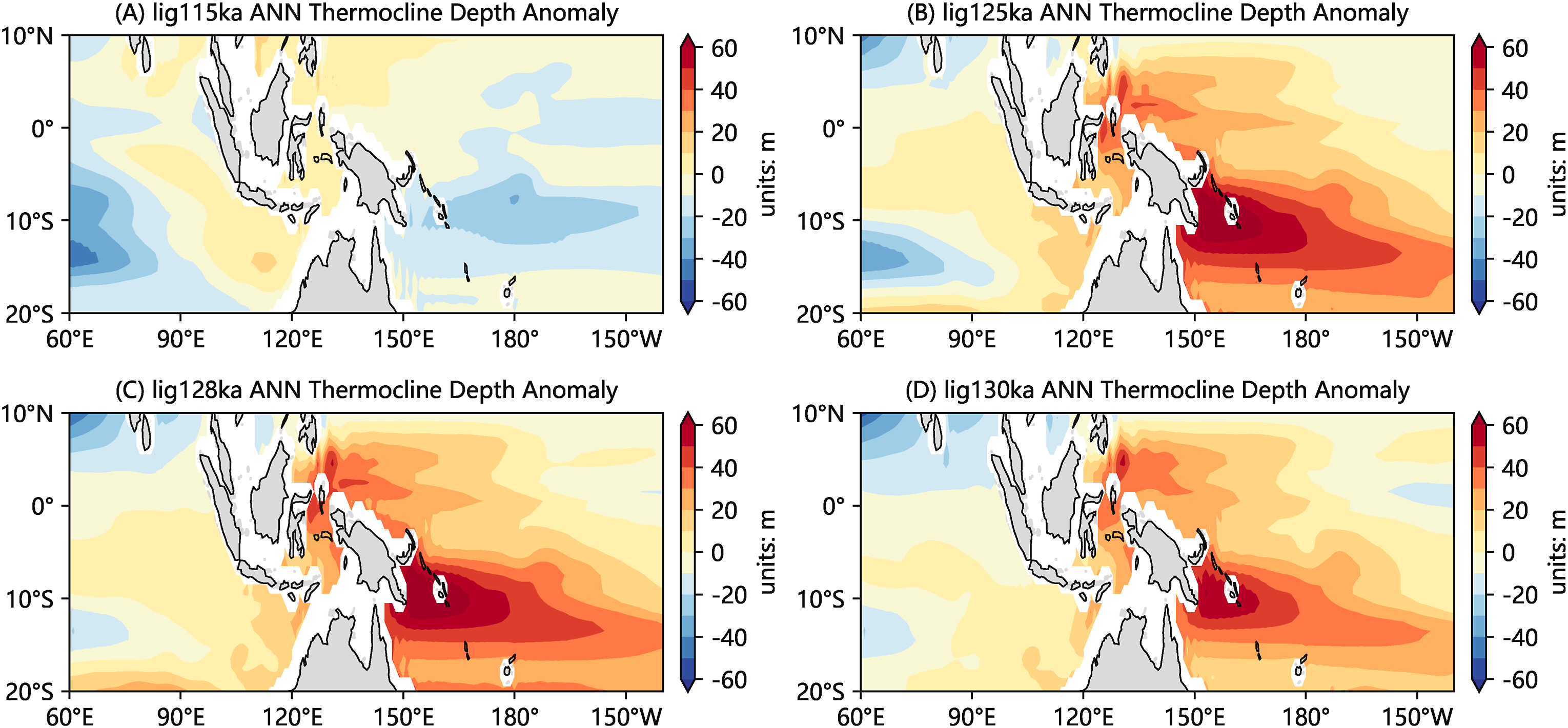
Abstract:The Indonesian Throughflow (ITF) is a key part of the global thermohaline circulation. However, the mechanisms and environmental impacts of the ITF in the geological past remain inadequately investigated. Here, we present model outputs from a set of Last Interglacial (LIG) snapshot simulations carried out by CAS-FGOALS (the Chinese Academy of Sciences Flexible Global Ocean–Atmosphere–Land System model) under the protocol of PMIP (Paleoclimate Modeling Intercomparison Project). Compared to the piControl simulations (the annual mean ITF flux was 18.46 Sv), an annual mean ITF flux increase of about 30.6%–35.9% was found in the early LIG snapshots (24.11–25.08 Sv). This enhancement of the ITF was closely correlated with a La Niña-like state and increased Pacific upwelling. During the LIG, an increased zonal sea surface temperature gradient and intensified easterlies in the tropical Pacific acted as positive feedback loop, resulting in a La Niña-like state with rising sea level in the western Pacific. As a result, the sea level gradient between the tropical western Pacific and the tropical eastern Indian Ocean increased, enhancing the pressure contrast between the two basins and ultimately strengthening the ITF volume transport. Additionally, increased North Atlantic Deep Water formation during the LIG led to enhanced Pacific deep upwelling, which contributed to the strengthening of ITF transport. Comparisons between models and proxies further support a La Niña-like state, enhanced Atlantic Meridional Overturning Circulation, and intensified ITF transport during the early LIG.
Full Article: https://doi.org/10.1016/j.quascirev.2026.110156