Decreased deep water oxygenation at Latest Pliocene in the Subantarctic South Pacific
Meile Wang a, Haowen Dang a,*, Sui Wan b, Wanyi Lu a, Wenshen Xiao a, Frank Lamy c,
Gisela Winckler d, Haiyan Jin a, Jian Xu e, Zhimin Jian a
* Corresponding author. hwdang@tongji.edu.cn (H. Dang).
a State Key Laboratory of Marine Geology, Tongji University, Shanghai, China
b State Key Laboratory of Tropical Oceanography, South China Sea Institute of Oceanology, Chinese Academy of Sciences, Guangzhou, China
c Alfred Wegener Institute (AWI) Helmholtz Centre for Polar and Marine Research, Bremerhaven, Germany
d Lamont-Doherty Earth Observatory, Climate School, Columbia University, Palisades, NY, USA
e State Key Laboratory of Continental Evolution and Early Life, Department of Geology, Northwest University, Xi'an, China
Abstract:
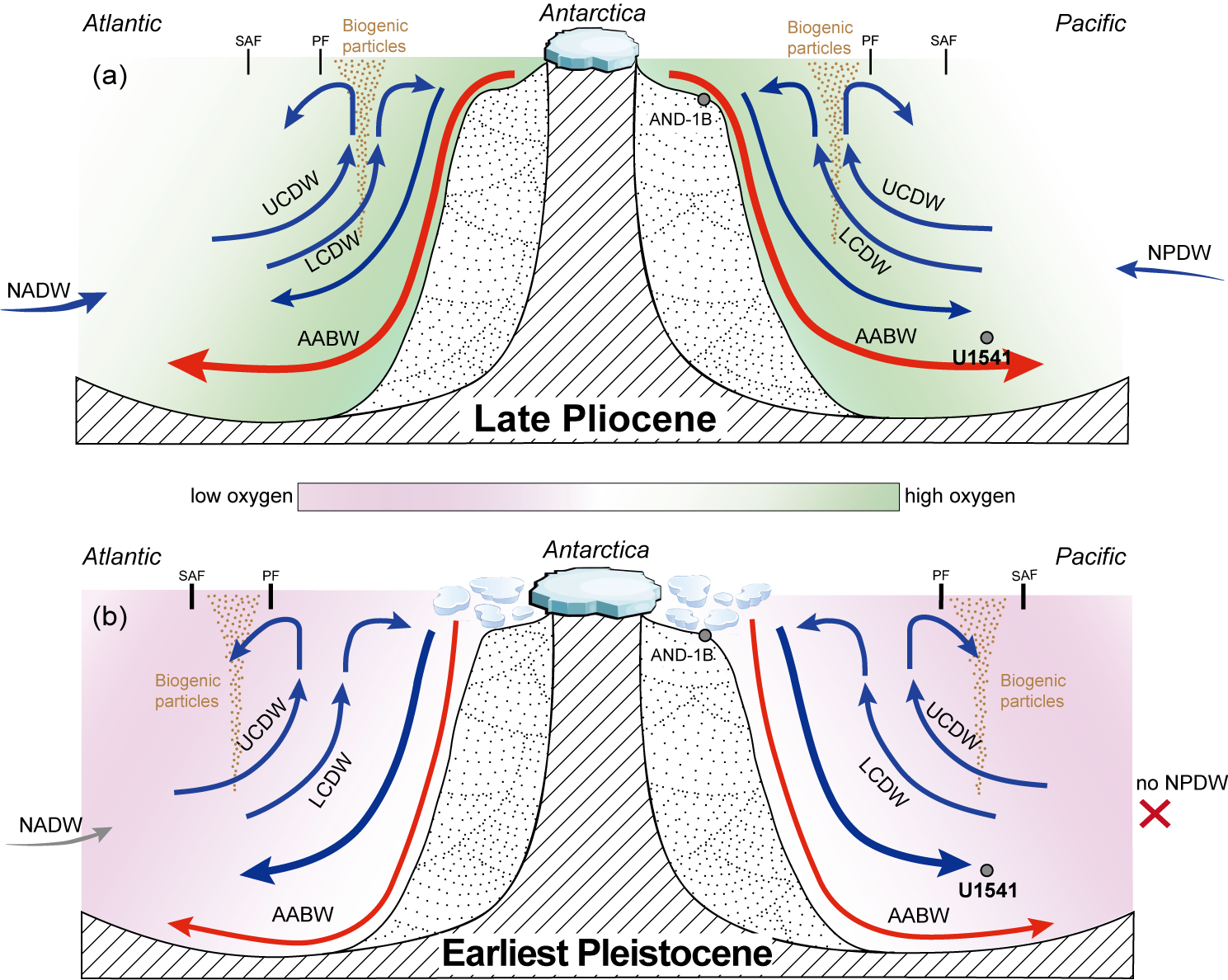
Deep-water masses originated from the Southern Ocean act as a critical driver of the cycling of heat, nutrients, and carbon among ocean basins, hence changes in the Southern Ocean deep waters would have profound impacts on global climate. However, such Southern Ocean variation during the intensification of Northern Hemisphere Glaciation (iNHG) has not been well documented. Here, we report benthic foraminiferal assemblage records across 3.5-2.2 Ma at IODP Site U1541 from deep Subantarctic South Pacific (SAP). Our results indicate a significant transition to less oxygenated deep-water conditions in SAP through 3.0~2.7 Ma, which is attributed mainly to the suppression of Antarctic Bottom Water ventilation and the reorganization of the Southern Ocean overturning circulation in SAP, due to the shifts of Western Antarctic shelves from open-water to ice-covered regimes in association with an equatorward migration of Southern westerlies and frontal systems. This deep SAP oxygenation reduction marks a deep-ocean overturning reorganization originated from Antarctic, serving as a key component of the ocean-climate changes during iNHG.
Full Airticle:https://doi.org/10.1016/j.quascirev.2026.110167