Wei Yuan1; Yang Zhang2; Zhenyu Yang3; Hai Cheng4; Xiaoxia Tu5; Lingmin Zhang1; Ting Hao6; Zilian Fan1; Huaiyang Zhou7
1.State Key Laboratory of Marine Geology, Tongji University, Shanghai 200092, China
2.Faculty of Geosciences, University of Bremen, Bremen 28359, Germany
3.Faculty of Geosciences, University of Bremen, Bremen 28359, Germany
4.Institute of Global Environmental Change, Xi’an Jiaotong University, Xi’an 710049, China
5.Zhejiang Ecological Civilization Executive Leadership Academy, Huzhou 313004, China
6.MARUM−Center for Marine Environmental Sciences, University of Bremen, Bremen 28359, Germany
7.Department of Ocean Science and Engineering, Southern University of Science and Technology, Shenzhen 518055, China
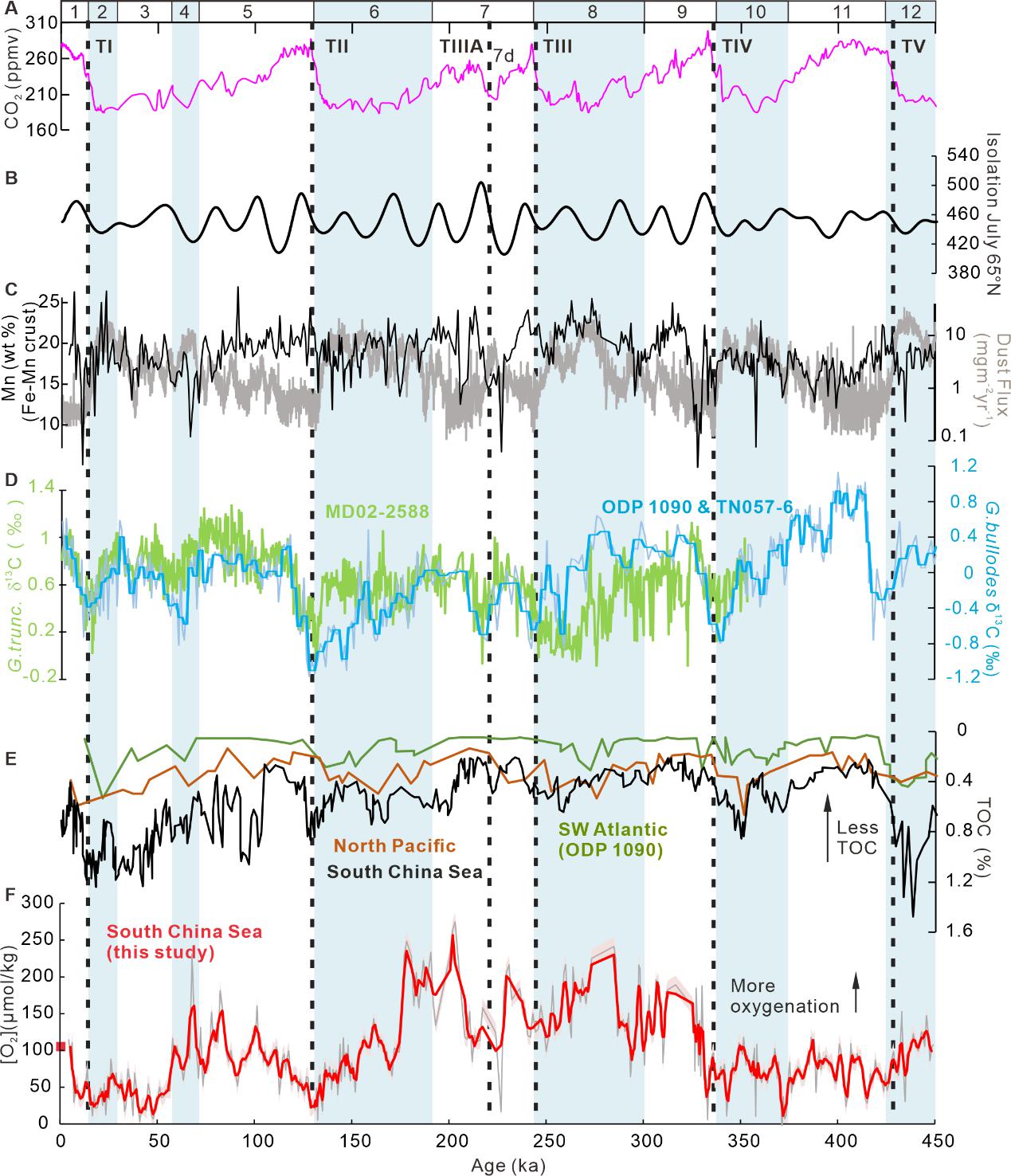
Abstract: Reconstructing dissolved oxygen (DO) variability in the deep ocean is critical for understanding the interplay between oceanic carbon storage and changes in climate over glacial−interglacial cycles. However, quantitative proxies that reliably resolve past DO fluctuations remain limited. Here, we develop an empirical Gompertz model framework to establish a nonlinear relationship between hydrogenetic iron concentrations in ferromanganese (Fe−Mn) crusts and ambient seawater DO levels. The derived relationship is expressed as [see PDF for equation], with R2 = 0.704. We demonstrate that Fe-oxyhydroxide precipitation in these crusts reflects a dynamic equilibrium governed by surface ocean iron fluxes and DO-dependent oxidation kinetics. Applying this proxy framework, we present the first quantitative reconstruction of deep-water DO variations in the western Pacific over the past 450 k.y. Our record reveals recurrent and pronounced DO depletions during glacial periods and terminations across the last three glacial cycles. Quantitative estimates further indicate substantially enhanced respired carbon sequestration in the abyssal western Pacific during the Last Glacial Maximum. These results constrain the spatiotemporal heterogeneity of DO variability and respiratory carbon distribution across Pacific water masses, thereby advancing our mechanistic understanding of oceanic respiratory CO2 partitioning during glacial cycles.
Full Article:https://doi.org/10.1130/B38887.1