Wenqin Cai1, Enqing Huang1*, Xiaotong Peng2, Shuangquan Liu2, and Jun Tian1
State Key Laboratory of Marine Geology, Tongji University, Shanghai 200092, China
Institute of Deep-sea Science and Engineering, Chinese Academy of Sciences, Sanya 572000, China
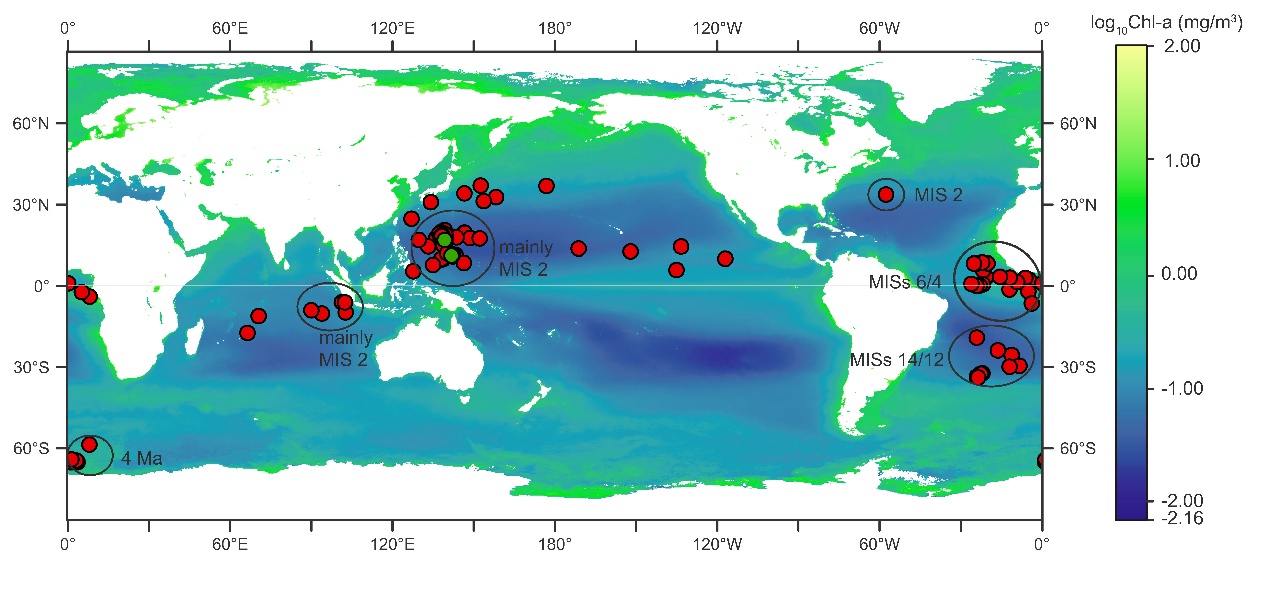
Abstract:The giant diatom Ethmodiscus rex exhibited widespread and episodic blooms in tropical and subtropical oceans during the late Quaternary, yet the mechanisms underlying their formation remain uncertain. A previous hypothesis emphasized the role of atmospheric dust input from inland Asia in triggering diatom blooms in the western Pacific. However, this interpretation has largely overlooked the physiological capacities of E. rex, including vertical migration and intracellular nutrient storage. Here, we use geochemical and isotopic analyses of sediment cores from the western North Pacific Gyre to constrain the timing and nitrogen availability of bloom events. Radiocarbon dating reveals that E. rex blooms occurred from the Last Glacial Maximum through the early Holocene, extending the temporal range proposed by earlier studies. Elevated Si/Ti and Ba/Ti ratios, increased biogenic opal concentrations, and higher bulk organic carbon δ¹³C values, indicate enhanced primary productivity and rapid consumption of dissolved inorganic carbon during bloom periods. However, limited organic-matter preservation suggests extensive remineralization during sedimentation. Most notably, a mean depletion of ~2.4‰ in organic matter δ¹⁵N relative to background values points to the utilization of isotopically light subsurface nitrate. We infer that upper ocean dynamics such as Rossby waves and internal oscillations intermittently uplifted the deeper nutricline, bringing nitrate-rich subsurface waters into an effective depth window for E. rex without penetrating the surface mixed layer. Within this window, nutrients could be effectively utilized, facilitating rapid proliferation under oligotrophic surface conditions. This mechanism remains hypothetical and requires further testing through proxy and modeling studies.
Full article:https://doi.org/10.1029/2025PA005236