Kun Zhang, Haibin Song, Peiwen Nian
State Key Laboratory of Marine Geology, Tongji University, Shanghai, 200092, China
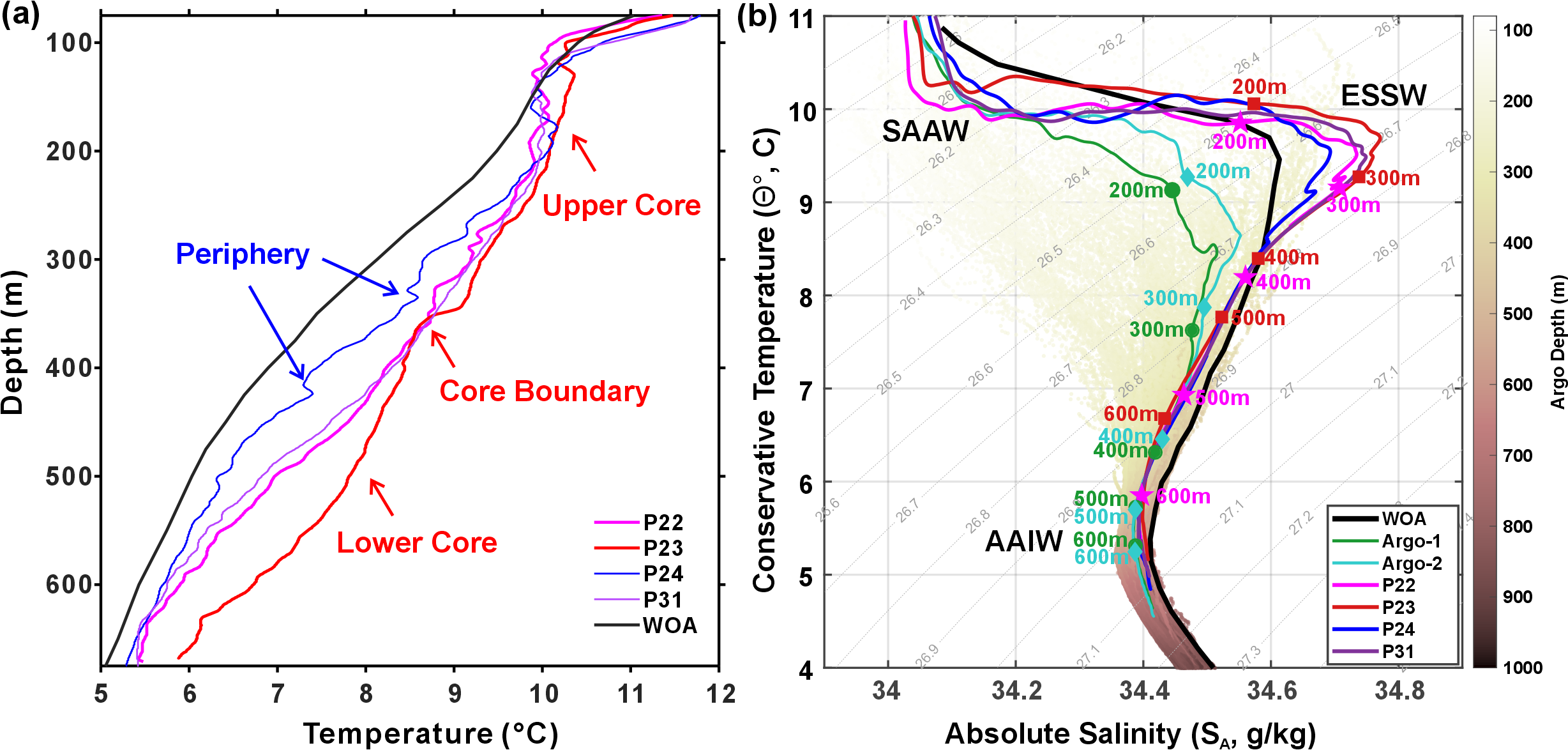
Abstract: Accurately characterizing the three-dimensional structure of oceanic eddies is essential for understanding how they transport water masses, tracers, and energy. Here we investigate a subsurface anticyclonic eddy observed in the eastern South Pacific using coincident multi-channel seismic reflection data, vessel-mounted Acoustic Doppler Current Profiler (vmADCP), satellite altimetry, and in situ hydrography collected in early 2017. The surface envelope defined by the Mesoscale Eddy Trajectory Atlas version 3.2 delayed-time product (META3.2 DT) was horizontally asymmetric, while the vmADCP sections revealed flank-dependent velocity structure and vertically displaced opposite-sign cross-track velocity extrema within a dual-core subsurface structure. Current speeds differed by 16%–27% between the sampled flanks, and the velocity structure showed apparent cross-sectional tilts of 0.12°–0.27°. The upper and lower cores had distinct water-mass signatures resembling Equatorial Subsurface Water (ESSW) and Antarctic Intermediate Water (AAIW), respectively. High-resolution seismic sections further revealed steep, edge-confined reflector bands, interpreted as finescale thermohaline structures or filaments within the eddy margin. The estimated turbulent kinetic energy dissipation rate was approximately one to two orders of magnitude higher in the sampled peripheral regions than in the core, whereas the dissipation maxima did not coincide with the strongest smoothed-field Rossby-number proxy or background shear. These observations show a relatively coherent, hydrographically differentiated dual-core interior surrounded by a finite-width, mixing-prone margin and demonstrate the value of seismic oceanography for resolving subsurface eddy structure and boundary mixing.
Full Article:https://doi.org/10.1029/2025JC023805