Peiwen Nian, Kun Zhang, Haibin Song, and Xinwei Li
State Key Laboratory of Marine Geology, Tongji University, Shanghai, China
Abstract
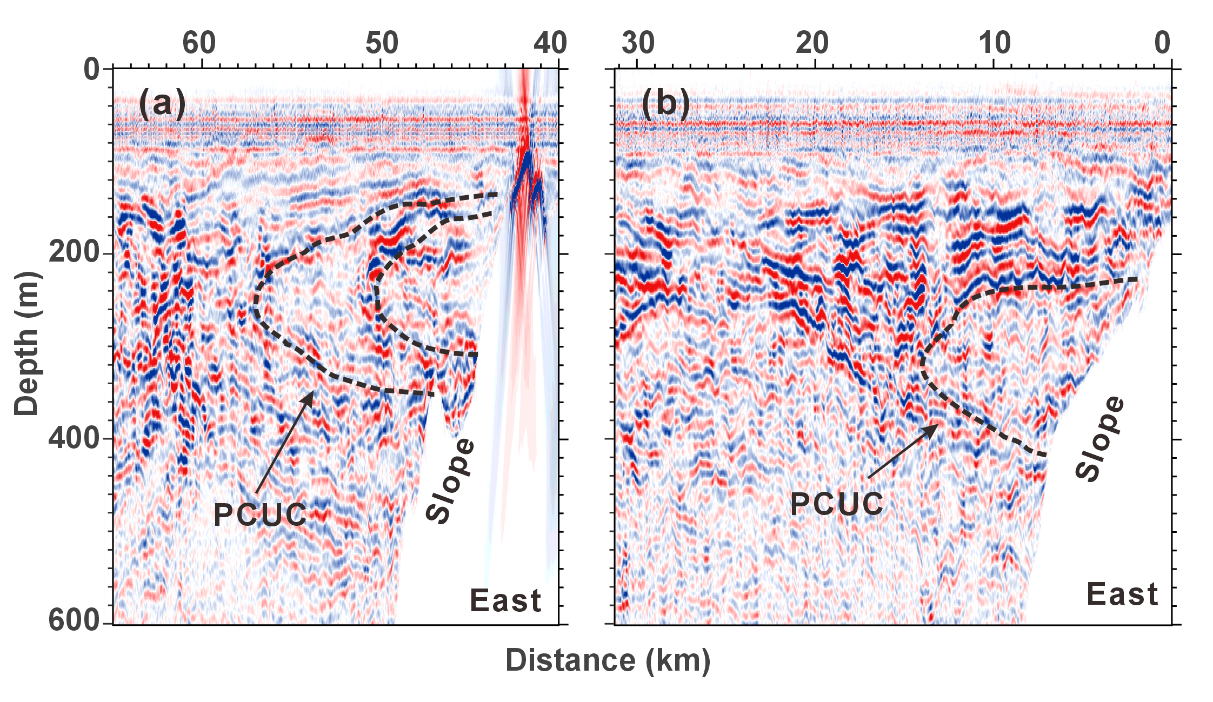
Subsurface eddies are a key component of eastern boundary upwelling systems, yet their structure and dynamics remain poorly constrained by observations. Using multichannel seismic reflection data combined with simultaneous shipboard acoustic Doppler current profiler (ADCP) measurements, we investigate two subsurface submesoscale anticyclonic eddies observed offshore of southern Chile in February 2017. Seismic imaging provides high-resolution constraints on the vertical structure and horizontal scales of the eddies, particularly their lateral boundaries. Based on the eddy geometry resolved from seismic imaging and coincident velocity observations, we conduct quantitative analyses of the eddy velocity structure and momentum balance. The estimated Rossby numbers indicate strongly ageostrophic dynamics, and a comparison of centrifugal and Coriolis terms shows that the radial momentum balance of both eddies is governed by gradient wind balance rather than geostrophic balance. The joint observations further reveal a strong poleward Peru–Chile Undercurrent (PCUC) near 44°S, with velocities of 0.1–0.2 m s−1, characterized by a distinctive seismic reflection signature along the continental slope. The spatial relationship among the eddies, the undercurrent, and local bathymetric curvature provides new observational evidence that subsurface anticyclonic eddies in eastern boundary upwelling systems can form through flow separation of the poleward undercurrent. These results demonstrate the value of combining seismic oceanography with velocity measurements to constrain the dynamics of subsurface submesoscale eddies.
Full Article:https://journals.ametsoc.org/view/journals/phoc/56/9/JPO-D-26-0036.1.xml