Pengfei Ma1, 2, Meichen Jiang3, Lin Zhang4, Chao Ma5, Han Cheng6, Qianfeng Huang7
1 State Key Laboratory of Marine Geology, Tongji University, Shanghai, China
2 Science Center, Deep Ocean DrillingProgram, Shanghai, China
3 College of Information Technology, Shanghai Jian Qiao University, Shanghai, China
4 HaikouMarine Geological Survey Center, China Geological Survey, Haikou, China
5 State Key Laboratory of Oil and GasReservoir Geology and Exploitation & Key Laboratory of Deep-time Geography and Environment Reconstruction andApplications of Ministry of Natural Resources & Institute of Sedimentary Geology, Chengdu University of Technology,Chengdu, China
6 Deep-time Digital Earth Research Center of Excellence, Hangzhou, Chin
7 CNOOC Research InstituteLtd., Beijing,China
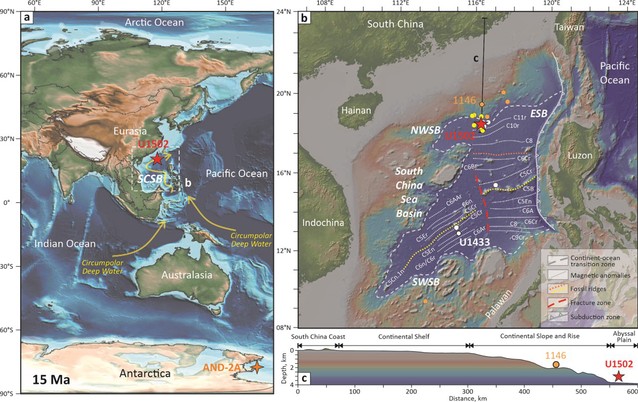
Abstract: The early-middle Miocene was a critical period of climate transition, marked by significant carbon cycle perturbations and dynamic changes in the Antarctic Ice Sheet (AIS). However, relatively quantitative understandings of how pelagic sedimentary systems responded to and participated in these changes remain limited. To address this gap, mass accumulation rates (MARs) for a low-latitude pelagic sequence recovered at International Ocean Discovery Program Site U1502 were calculated to evaluate sediment erosion, transport, and deposition. Enabled by a robust, high-resolution age model established here, we quantified interactions between pelagic MARs and sea level through cross-recurrence analyses. Integrating additional climate proxies such as atmospheric CO2 and illite crystallinity, our results demonstrate that cryospheric evolution acted as a critical boundary condition in modulating the long-term climatic response mode of low-latitude pelagic sedimentation. During the Miocene Climatic Optimum (MCO) and Middle Miocene Climate Transition (MMCT), when the AIS underwent landward retreat, pelagic MARs responded positively to global changes. This means that higher pelagic MARs occurred during warmer and wetter periods, and vice versa. In contrast, during periods of significant AIS expansion before the MCO and after the MMCT, sea-level fluctuations strongly modulated shelf accommodation, thereby buffering terrigenous inputs and leading to lower pelagic MARs despite warmer, wetter climate conditions. Furthermore, we found that pelagic sedimentation may mitigate positive benthic δ13C excursions in the middle Miocene, motivating future broader perspectives on this relationship.
Full Article:https://doi.org/10.1029/2025PA005243